
When should you take your child to the dentist for the first time?


23.07.2025
373
6 min. read
Why Patients Trust Dynasty Stomatology
The trust in Dynasty Stomatology is built on a combination of many years of experience and an individual approach to every patient. We understand that a visit to the dentist is often accompanied by anxiety, so we place special emphasis on creating a comfortable and calm atmosphere where every patient feels safe.
The clinic is equipped with modern technology and uses advanced treatment methods, ensuring that procedures are carried out with maximum precision, efficiency, and comfort. All materials undergo strict quality control, and our doctors regularly improve their qualifications to offer only the most up-to-date and proven techniques.
In addition, Dynasty Stomatology values long-term relationships with patients. Our goal is not only to solve the problem at hand but also to maintain the health of teeth and gums for years to come. Openness, honesty, and transparency are the key principles that have earned the clinic its reputation as a reliable dental partner.
Facts about Dynasty Stomatology:
✅ Over 10 years of successful work in dentistry.
✅ Hundreds of positive reviews from patients in Poland and abroad.
✅ We use premium materials from leading global brands.
✅ We offer treatment under sedation and general anesthesia.
✅ A full range of services — from pediatric dentistry to complex surgical operations.
Dynasty Stomatology — trust, expertise, reliability, and care for the beauty of your smile.
Learn about usMedical Expertise
Dynasty Stomatology’s doctors conduct medical reviews of all materials on the website to ensure their accuracy and practical value. Our authors and editors are experienced specialists in the fields of therapeutic, surgical, orthopedic, and pediatric dentistry. This approach allows us to maintain high professional standards and provide our readers with only verified, up-to-date, and useful information.
Taking your child to the dentist for the first time is a big step – and it’s normal for parents to have plenty of questions. When should a child first see a dentist? What actually happens during that first appointment? Visiting a dentist early not only supports healthy teeth from the beginning, but also helps build habits that support good oral health long-term. In this article, we’ll look at the right time to take your baby to the dentist, what to expect at the first dental visit, and how to help your child feel comfortable with the dentist from day one.
When should babies start going to the dentist?
Babies should start going to the dentist within six months of the appearance of their first tooth, and no later than their first birthday. According to the American Academy of Pediatric Dentistry, this early first dental visit helps monitor baby teeth development and lays the foundation for lifelong oral health. Scheduling a first dentist appointment at this stage allows the pediatric dentist to identify any early concerns and guide parents on proper dental care.
Why do baby teeth matter so much?
Healthy baby teeth play a big role in your child’s overall development. Regular dental visits help ensure their smile stays on track. Here’s why early dental care is so important:
- Baby teeth help your child chew and speak properly.
- They guide permanent teeth into the correct position.
- You can find out if the cleaning you do at home is working.
- Your dentist can spot and fix problems early.
- Your child learns that visiting a dentist is a normal part of staying healthy.
- Seeing the dentist regularly helps your child feel comfortable in the dental chair.
How to prepare your child for their first visit to the dentist
To make your child’s first dental visit smooth, prepare your child with simple, positive language and role play. Stay calm and informed yourself, and let the pediatric dentist know your child’s age and temperament.
If a child is seeing a dentist for the first time, it’s also important to consider their age-specific needs:
- 10 to 24 months. Some securely attached children may get upset when taken from their parents for an exam.
- 2 to 3 years. A securely attached child may be able to cope with a brief separation from parents. In a 2-year-old, “no” may be a common response.
- 3 years. Three-year-olds may not be OK being apart from a parent when having a dental procedure such as getting a cavity filled. This is because most 3-year-olds are not socially mature enough to separate from parents.
- 4 years. Most children should be able to sit in another room from parents for exams and treatment procedures.
What should I expect at my child’s first visit to the dentist?
Your child’s first dental appointment is a key moment for building lifelong oral health habits. Understanding what happens during this visit can help both you and your child feel more prepared and relaxed.
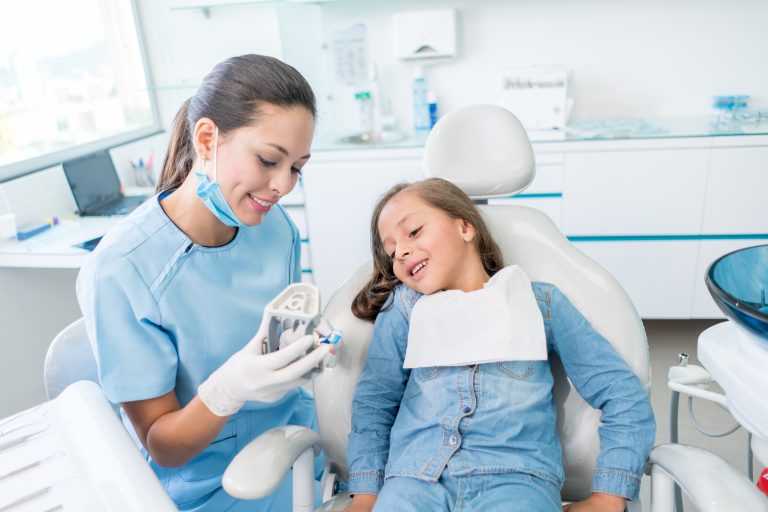
At your child’s dental appointment, a hygienist will:
- Examine and clean your baby’s teeth;
- Show you how to play a role in properly cleaning your baby’s teeth;
- Discuss diet and fluoride needs;
- Recommend oral care products.
Your dentist will then join you and your baby. They will:
- Examine your baby’s mouth closely to check for any tooth decay;
- Share any concerns they may have regarding your baby’s oral development;
- Answer all of your questions regarding your baby’s teeth and oral development.
Topics your dentist may discuss with you;
- Good oral hygiene practices for your child’s teeth and gums;
- Cavity prevention, including best practices for brushing and flossing4
- Fluoride needs;
- Oral habits (like thumb sucking, tongue thrusting and lip sucking);
- Developmental milestones;
- Teething;
- Proper nutrition;
- Scheduling future dental visits.
Protect your children’s teeth at home
Proper care at home is essential before and after your child’s first dentist visit to keep children’s teeth healthy and prepare them for regular dental visits. Starting early with good habits helps prevent decay and makes going dentist easier for your little one.
- Before the first tooth appears, clean your baby’s gums gently with a clean, damp cloth.
- Once the first tooth erupts, brush twice daily with a small, soft-bristled toothbrush and a rice-sized amount of toothpaste.
- After age 3, when your child can spit, use a pea-sized dab of fluoridated toothpaste to protect child’s dental health.
- Prevent baby bottle tooth decay by avoiding milk, juice, or sweetened drinks at bedtime or nap time.
- Limit bottle feeding to 5-6 minutes per session to reduce prolonged sugar exposure.
- Help your child brush their teeth until age 7 or 8, encouraging them to copy your brushing pattern to cover all areas.
- Limit sugary snacks and sticky treats that increase the risk of cavities; offer fresh fruit instead of juice to naturally clean children’s teeth.
Following these steps will support your child’s oral hygiene between baby’s first dental visit and subsequent dental checkups. Be sure to book your child’s first dental appointment around their first birthday to begin preventive care with a trusted pediatric dentist or family dentist.
Choosing a dentist for your child
When selecting a child’s dentist, look for someone experienced in dental pediatrics who makes your little one feel comfortable and safe. It’s important to find a pediatric dentist skilled in caring for children’s teeth from the age first dentist visit is recommended—typically by dentist by age 1 or within 6 months of the first tooth. A good dentist will guide you through your child’s first dentist appointment and support healthy habits for life.
Conclusion
It’s best to take your child to their first dental visit around their first birthday. Starting early helps them feel at ease with both the dentist and the dental chair. These visits give parents a chance to check that everything is developing normally and that dental hygiene is being maintained. Helping your child feel relaxed during appointments sets a strong foundation for healthy habits later on.
At Dynasty Stomatology, our expert kiddies dentist team is dedicated to gentle care and making every first dental visit positive. Book your child’s first dental appointment with us and ensure the best start for your child’s smile!
FAQ:
-
How do I know if a dentist is qualified to treat young children?
A qualified pedia dentist has specialized training beyond dental school to care for children’s teeth and understands the unique needs of infants and toddlers.
-
What signs of dental problems in babies should I watch for at home?
Look for discoloration, white or brown spots on first teeth, excessive drooling, or discomfort that may indicate issues needing an infants dentist.
-
Are there red flags during teething that require a dental visit?
If your baby has severe pain, swelling, or fever beyond normal teething symptoms, it’s best to visit the dentist promptly.
-
What’s the difference between pediatric and general dentists?
A pediatric dentist specializes in treating babies and children, while general dentists usually see patients of all ages without this specific focus.
-
Should I take my child to the dentist if they have no visible teeth yet?
Yes, early visits to an infants dentist help establish good oral care routines and prepare your child for their first dental visit once the first teeth first appear.
-
How do I manage a child’s dental anxiety before their first visit?
Use positive language about going to the dentist, read children’s books on dental visits, and choose a friendly pedia dentist who makes your child feel comfortable.
-
Can early dental visits help with speech development or oral habits?
Yes, dentist pediatric care can support proper oral development and address habits like thumb sucking early on.
-
Are digital X-rays safe for young children if needed?
Yes, digital X-rays use very low radiation and are considered safe when performed by an experienced pediatric dentist.
-
What dental products should I avoid using for my child?
Avoid products not designed for childrens teeth or those with excessive fluoride if your child is under age 3.
-
How can I balance encouraging independence while still helping my child brush effectively?
Encourage your child to brush while you supervise and assist, making sure they learn proper techniques before gradually gaining independence with your support.


Do you want to treat your teeth while you sleep?
Schedule an appointment!
By clicking the button, you give your agreet your personal data in accordance with privacy policy.
Services related to this topic
All services-
Milk teeth removal in Prague
It is not always possible to save baby teeth, sometimes they need to be removed to form a correct bite and a healthy smile of the child. In Prague,...
To the service -
Children’s dental hygiene with training in Prague
Children’s dental hygiene and training in proper home care is about taking care of oral health from an early age. Dynasty Stomatology in Prag...
To the service -
Consultation with a pediatric dentist in Prague
Regular visits to a pediatric dentist not only help identify problems at early stages, but also form a positive attitude towards dental care. Durin...
To the service -
Treatment of caries in milk teeth
Many parents mistakenly believe that it is not necessary to treat decayed baby teeth, because they will soon fall out and be replaced by permanent ...
To the service -
Teeth fluoridation for children
Dental caries in children develop rapidly, especially if the enamel is weak and hygiene is inadequate. Many parents are faced with the fact that ev...
To the service -
Fissure sealing for children
Fissure sealing in children is one of the most effective ways to protect teeth from decay. Deep natural cavities on the chewing surface often becom...
To the service -
Treatment of malocclusion in children – pediatric orthodontics
Bite treatment in children is one of the key tasks of pediatric orthodontics. Occlusal disorders often occur in childhood and can lead not only to ...
To the service



Read also
View all blog-
07.07.2026
8
13 min. read
Cavity – causes, symptoms and treatments
Most people think of tooth decay as simply a small hole in the tooth that will eventually need to be filled. In fact, it begins much earlier. Month...
Read more -
03.07.2026
30
8 min. read
Dental Pulpitis Treatment — Saving a Tooth From Pain and Loss
Have you ever experienced a sudden, sharp toothache? It might seem like a reaction to something cold or the aftereffects of eating something sweet....
Read more -
02.07.2026
35
12 min. read
How to Fix Tooth Sensitivity – The Complete Guide to Fast Relief and Permanent Solutions
Have you ever felt a sharp pain when taking a sip of hot coffee or eating your favorite ice cream? One day, everything was fine, but the next, your...
Read more -
30.06.2026
57
10 min. read
Endodontic Retreatment – Why Root Canal Treatment Sometimes Needs to Be Repeate
Most people believe that root canal treatment solves the problem forever. In most cases, this is precisely what happens. However, sometimes, after ...
Read more -
08.06.2026
79
9 min. read
What is Oral Thrush – Symptoms, Treatment and Prevention
Have you noticed a white coating on your tongue that doesn’t go away even after brushing your teeth? Or a strange burning sensation in your m...
Read more -
05.06.2026
70
8 min. read
Dental Care For Pregnant Women – What you need to know
Pregnancy affects nearly every part of the body — including teeth and gums. Many women notice bleeding gums, increased sensitivity, or sudden tooth...
Read more -
03.06.2026
146
11 min. read
What to Do After a Wisdom Tooth Extraction – a Guide to Healing and Care
Going to the dentist to have a wisdom tooth removed often brings fear and many questions, both before and after. For example, is it normal for my c...
Read more